Gujarat GCC Policy 2025-30 could influence where a company establishes its next Global Capability Center—but financial incentives are only one part of the decision. Businesses also need to understand eligibility, claim deadlines, property requirements and the cost of making an office operational.
For companies evaluating GCCs in Ahmedabad or GIFT City, this guide brings together the February 2025 policy, the September 2026 operational-guidelines update and a practical workplace-planning checklist. It separates official incentive limits from real estate prices and interior-design budgets, so the numbers are not mistaken for guaranteed savings.
Quick answer: Gujarat’s GCC policy targets 250 new centres, more than 50,000 jobs and ₹10,000 crore in investment. Eligible GCCs may access capital, operating, employment and other assistance, subject to conditions. The state listed Operational Guidelines 1.0 on 21 September 2026 to clarify recognition, documentation and claims. These are policy targets and possible benefits—not approved company payouts.

Gujarat GCC Policy 2025-30: Key Facts at a Glance
| Policy detail | Official position |
|---|---|
| Notification | 11 February 2025 |
| Policy operative period | Until 31 March 2030 or an earlier replacement/revision |
| Applications for incentives | By 31 March 2030, subject to applicable rules |
| Commencement of operations | By 31 March 2031 for eligible applications |
| Minimum payroll | 50 employees |
| Policy ambition | At least 250 GCCs, 50,000+ jobs, ₹10,000 crore investment |
| Operational Guidelines 1.0 | Government resolution dated 21 September 2026 |
Primary sources: Gujarat Department of Science & Technology: GCC Policy and its government resolutions register.
What Is a Global Capability Center (GCC)?
A Global Capability Center is an operation established by a multinational or domestic group to support its parent or group organisation. Its functions may include engineering, research, analytics, technology, finance and specialist business operations. An international manufacturer might operate an engineering GCC, while a financial-services group might establish one for technology or risk analytics.
Not every corporate office is a GCC. Check the policy’s activity and ownership requirements before relying on incentives.
Gujarat GCC Policy 2025-30: 7 Key Incentive Benefits
The benefits below are maximum policy provisions for eligible entities. They are not market quotations, guaranteed reimbursements or proof that a particular invoice qualifies. In particular, land cost is excluded from the policy’s definition of Gross Fixed Capital Investment (GFCI).
1. Capital expenditure (CAPEX) assistance
For qualifying investments, the policy offers up to 20% support on eligible building construction or purchase and related fixed assets, and up to 30% on eligible computers, software and networking hardware. The total assistance ceiling is ₹50 crore for Category I and ₹200 crore for Category II. The policy describes disbursement in 20 equal quarterly instalments, with further annual restrictions.
Not every interior-design invoice automatically attracts a subsidy. According to October 2026 reporting on Operational Guidelines 1.0, qualifying furniture, fixtures, renovation, civil work, interior designing, electrical items and HVAC may be considered on the basis of supporting documents. Companies should verify each expenditure category with the official guidelines and sanctioning authority.
2. Operating expenditure (OPEX) support
The policy specifies assistance of up to 15% of eligible annual OPEX, with an annual ceiling of ₹20 crore for Category I or ₹40 crore for Category II, over the applicable five-year period. Eligible heads include specified office lease rental, bandwidth, cloud rental and power tariff expenditure.
Additional caps apply to bandwidth and cloud rental; their treatment is not simply an unlimited 15% reimbursement. Finance teams should classify expenditures correctly before projecting assistance.
3. Employment generation incentive
For a new eligible local employee retained for at least one year, the policy offers a one-time incentive calculated at 50% of one month’s CTC, capped at ₹50,000 for a male employee and ₹60,000 for a female employee. The incentive can only be claimed once in an individual’s lifetime, even if the person later joins another GCC.
4. Interest assistance
Eligible loans may attract interest support at up to 7% or the actual eligible interest paid, whichever is lower, with a ceiling of ₹1 crore per year for up to five years. The eligible loan amount is capped at 70% of eligible GFCI. The original policy excludes loans from non-banking financial companies (NBFCs) and specifies additional lender, disbursement and commencement conditions.
5. Employer EPF contribution support
Under the Atmanirbhar Gujarat Rojgar Sahay provision, the policy specifies reimbursement of qualifying employer EPF contributions for up to five years: 100% for eligible female employees and 75% for eligible male employees. The per-person ceiling is linked to 12% of the applicable basic salary, DA and retaining allowance. This is distinct from the one-time employment generation incentive.
6. Electricity duty incentive
Eligible GCC units may claim the electricity duty paid to the Government of Gujarat for the specified five-year period. This does not mean the entire office electricity bill is reimbursed: electricity duty and electricity consumption charges are different items.
7. Skills and quality-certification support
Specified recognised training can qualify for assistance of up to ₹50,000 per qualifying course/beneficiary, subject to different caps for students and working professionals. Eligible GCC units may also receive 80% of quality-certification fees, up to ₹10 lakh in total, for no more than five certifications within the policy period.
For the full terms, consult the Government of Gujarat policy rather than estimating a company’s entitlement from a headline percentage.
Who Qualifies? Category I vs Category II and Critical Deadlines
The policy covers qualifying new or existing units establishing or expanding eligible GCC operations in Gujarat. An eligible unit must have at least 50 employees on payroll. If headcount stays below 50 for three consecutive months, further fiscal assistance is discontinued under the original policy.
| Category | How it is defined | CAPEX ceiling | Annual OPEX ceiling |
|---|---|---|---|
| Category I | GFCI below ₹250 crore | ₹50 crore | ₹20 crore |
| Category II (mega project) | GFCI of ₹250 crore or more OR at least 500 direct payroll jobs | ₹200 crore | ₹40 crore |
Important: Category II does not require both thresholds to be met; the policy states investment OR employment. These are maximum assistance ceilings, not standard grants.
The policy remains operative through 31 March 2030, unless an earlier revision or replacement is notified. Eligible applicants must apply by that date and meet the applicable commercial-operation deadline of 31 March 2031. An early-stage company must also satisfy the actual GCC definition, not just the size and date criteria.
What’s New in the September 2026 GCC Operational Guidelines?
The Gujarat Department of Science & Technology lists Operational Guidelines 1.0 dated 21 September 2026 under resolution DST/GCC/e-file/24/2026/1101/IT. They describe how GCC recognition, proof of eligibility, applications and claims are to be managed. The government resolution is listed in its official register.
According to detailed reporting published 3 October 2026, companies must use an integrated incentive-management portal. A new month of eligibility considers three milestones—commercial operations, in-principle approval and achieving the required eligible payroll—and uses the latest qualifying milestone.
Reported supporting documents include a board resolution, ownership or group-company details, a service-level agreement, a detailed project report, GST registration, payroll records, invoices and CA-certified statements where required. The same reporting identifies time-bound claim procedures: CAPEX claims are financial-year based, the initial OPEX claim covers two quarters, and later OPEX claims run quarterly. Late claims may face pro-rata deductions.
Practical lesson: Build a documentation trail before commencing fit-out or procurement. Preserve scopes of work, contracts, dated invoices, payment evidence, equipment schedules and handover records. Do not assume a retrospective cost estimate will satisfy a government claim.
Verification note: The issuance date is confirmed by the government register; procedural details above are attributed to contemporary reporting. Applicants should inspect the actual Operational Guidelines 1.0 and obtain professional advice before filing a claim.
GCC in Ahmedabad vs GCC in GIFT City: Which Office Questions Matter?
Companies exploring a GCC in Ahmedabad may compare city commercial districts with GIFT City in the Gandhinagar region. The appropriate choice depends on their workforce, operational model, property availability, building systems, lease terms and any sector-specific regulatory needs.

- Talent and commute: Where will employees travel from, and will shift patterns affect accessibility?
- Building readiness: Can power, HVAC, connectivity, fire-safety systems and access control support the proposed operation?
- Commercial terms: Which services and tenant improvements are excluded from rent or service charges?
- Confidentiality: Are secure rooms, controlled visitor movement and quiet work areas required?
- Growth: Can the workplace absorb expansion without major disruption?
Operating in GIFT City does not automatically mean a company qualifies for a particular GCC subsidy, financial-services permission or tax regime. Those questions require separate, case-specific regulatory checks.
The Most Misread Figures: 60 Sq Ft per Employee and ₹3,000/Sq Ft
The original Gujarat GCC policy sets a ₹3,000 per sq ft cap on expenditure for new building construction in a specified CAPEX calculation. It computes the relevant built-up area using 60 sq ft per eligible payroll employee.
This is not an office design standard or a market construction quotation. For example, 50 eligible employees multiplied by 60 sq ft gives 3,000 sq ft for that policy calculation. Multiplying this by ₹3,000 produces ₹90 lakh as the illustrative construction-expenditure calculation cap, before assistance percentages, approvals and other limitations. It does not establish the right office area or guarantee a ₹90 lakh payment.
Similarly, the policy’s specified office lease OPEX calculation uses the lower of actual eligible rent or ₹50 per sq ft per month. This is an assistance-calculation threshold—not an Ahmedabad rental-market rate.
A real GCC can require more or less area per employee because of conference rooms, secure technical facilities, equipment, reception, circulation, amenity provision and growth assumptions. It is essential to keep subsidy calculations separate from space planning and quotations.
Before You Lease or Fit Out a GCC Office: A 7-Point Checklist
- Define operations first. Document headcount, departments, privacy requirements, visitor flow, shift patterns and target expansion.
- Check the building. Verify permitted use, landlord scope, services capacity, fire protection, access, building approvals and relevant regulations.
- Zone the workspace. Plan focused work, meeting areas, collaboration, leadership, storage and circulation before selecting finishes.
- Coordinate technical systems. Bring networking, security, power, lighting, acoustics and cooling requirements into the early design discussion.
- Compare quotations on equivalent scope. Separate civil works, partitions, MEP, HVAC, cabling, furniture, professional fees, taxes and contingency.
- Agree on delivery responsibilities. Specify who designs, approves, procures, manages the site, handles changes and supplies completion documentation.
- Keep audit-ready evidence. Maintain contracts, drawing approvals, asset-wise invoices, certificates and proof of payment alongside payroll and company records.
Businesses comparing a coordinated design-to-execution approach can read Saara Spaces’ turnkey interior solutions guide and its commercial interior design guide.
What Real Ahmedabad Office Projects Can Teach GCC Planners
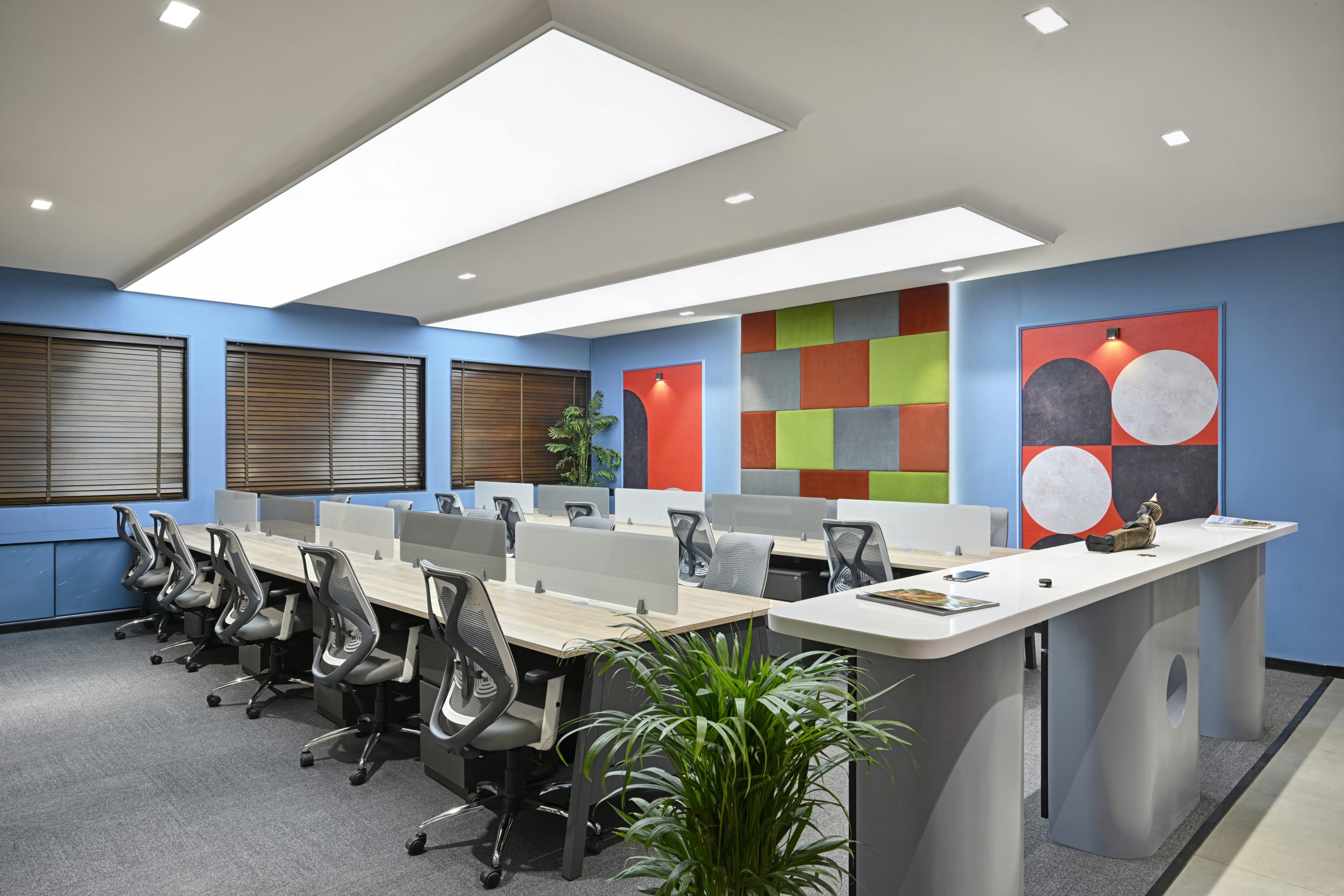
Saara Spaces has completed compact corporate interiors in Ahmedabad. The following are real commercial-office examples, not GCC installations. They illustrate the value of matching space planning to work requirements rather than choosing a layout for appearances alone.
Shivam Logistics: 326 Sq Ft Office in Jagatpur
The Shivam Logistics office project combines a reception, linear workstations, private executive cabin and glass partitions within a 326 sq ft commercial interior. Warm wood, a geometric ceiling and logistics-themed graphics contribute to its distinct business identity.

MK Construction: 283 Sq Ft Office in Bopal
The MK Construction project demonstrates how contemporary workstations, thoughtful circulation and brand-inspired design can support a compact office. Although a larger GCC has different operational requirements, careful functional zoning remains relevant at every scale.
For more examples of the planning decisions behind smaller offices, see compact office design lessons from Ahmedabad projects.
Planning a GCC or Corporate Workspace in Ahmedabad?
Policy interpretation belongs with the relevant government authority and qualified advisers. For the physical workplace, Saara Spaces can discuss space planning, interior design and agreed design-to-execution scope using the team’s experience with completed commercial projects.
Discuss Your Ahmedabad Office Project With Saara Spaces →
Share your project location, approximate area, team requirements and current stage so the first consultation can focus on meaningful workspace decisions.
Gujarat GCC Policy 2025-30: Frequently Asked Questions
What is the Gujarat GCC Policy 2025-30?
It is the Gujarat government’s incentive policy for qualifying Global Capability Centers. Announced in February 2025, it outlines support for eligible capital investment, operating costs, employment and other specified expenditure.
Does every office with 50 employees qualify for GCC incentives?
No. The 50-employee payroll threshold is one requirement. The operation must also satisfy the policy’s definition of a GCC and all applicable eligibility and documentation rules.
What qualifies a GCC as a Category II mega project?
Under the original policy, a qualifying mega project requires GFCI of at least ₹250 crore or at least 500 direct payroll jobs, subject to all other policy conditions.
What is the September 2026 GCC update?
Operational Guidelines 1.0, listed on 21 September 2026, establish more detailed recognition, incentive-application and claim procedures, including supporting documentation and timing requirements.
Can office interiors and HVAC be covered by GCC assistance?
October 2026 reporting on the guidelines says certain furniture, renovation, interior-design, electrical and HVAC costs may be considered with supporting documents. Eligibility is not automatic and should be confirmed with the sanctioning authority for each expense.
Does 60 sq ft per employee determine the required GCC office area?
No. The figure is used in an official calculation for eligible new-building construction expenditure. It is not a substitute for architectural planning, building regulations or workplace requirements.
Is ₹50 per sq ft the rent for GCC office space in Ahmedabad?
No. The ₹50 per sq ft per month figure is an OPEX rental-assistance calculation limit. Market rents and project budgets are separate commercial matters.
When does the Gujarat GCC Policy application period end?
The original policy says eligible entities must apply for assistance by 31 March 2030 and commence operations by 31 March 2031, subject to revision and all applicable conditions.
Final Takeaway
The Gujarat GCC Policy 2025-30 is more than a list of headline subsidies. A useful investment decision requires understanding which business activities qualify, when eligibility begins, how expenditure is documented and what it will really take to operate an office in Ahmedabad or GIFT City.
The safest sequence is to verify the policy with the government, assess the building against actual operating needs, establish an accountable design-and-execution scope, and retain the supporting records. That approach reduces the risk of confusing a policy calculation with a commercial quotation.
Editorial disclaimer (29 October 2026): This article summarises published policy material for general information; it is not legal, financial, tax, or incentive-claim advice. Official circulars and future amendments prevail. Saara Spaces does not claim to have secured GCC incentives for the featured projects.